
More than a third of 83 mainboard IPOs this year ended their debut sessions in the red, with losses of up to 35 per cent.

'Equities may not outperform every year, but if they do so seven times out of 10, it's an asset class worth relying on.'

This marks the strongest DRHP filing tally since 1996, when 428 firms sought to enter India's equity markets.

For LG Electronics India, the Rs 11,607 crore initial public offering (IPO) is not just a fundraising exercise. The company's senior executives describe it as a step towards becoming "future-ready", showcasing financial strength while preparing for the next phase of growth in a market they see as still underpenetrated.

'If not bullish, volatility should be minimal.'

'It's better to stay away from large IT stocks until there is clarity on tariffs.'

Last fortnight, State Bank of India Chairman C S Setty lifted the veil on a subject long spoken of in corporate corridors: Why can't our banks finance mergers and acquisitions (M&As)? Change is in the air: Indian Banks' Association (of which Setty is the chairman) is to "make a formal request" to Mint Road to make way for it. Thus far the exclusive turf of foreign banks even though its funding remains offshore - as in, it's not on these entities rupee-book (and a few select shadow banks) - a most lucrative segment in the investment banking suite, M&As, will be homeward-bound.

After a subdued first quarter of 2025-26 (Q1FY26), banks are now betting big on the festive season, rolling out attractive loan offers to boost credit growth in the second half of the current financial year (H2FY26) - a trend likely to be further accentuated by the second-order effects of the good services tax (GST) cuts.

Domestic institutional investors (DIIs) poured in Rs 94,829 crore of fresh money into Indian equities in August, the second-highest monthly inflow after record Rs 1.07 trillion influx in October 2024.

India Inc, which is sitting on cash balances of 13.5 trillion, is using the funds to meet capital expenditure as well as brownfield expansion, resulting in 'anaemic' demand for bank loans, State Bank of India (SBI) chairman CS Setty said at an event on Monday. He added that a slowdown in corporate credit is mainly due to lack of demand.

Some public sector banks, including State Bank of India (SBI), Union Bank of India, Canara Bank, and Bank of India, are increasing the spread on home loans for new customers to protect margins.

Pre-initial public offering (IPO) allotments have fallen out of favour over the past two years amidst buoyant primary markets and increasing average float sizes. In 2023, 13 firms raised a record Rs 1,074 crore through pre-IPO placements.

Commercial banks in India reported 26 per cent year-on-year (Y-o-Y) growth in slippages at Rs 63,000 crore during the first quarter ended June 2025 (Q1FY26). This was predominantly due to stress in microfinance and unsecured retail portfolios of select lenders.

Domestic markets saw the addition of nearly 3 million new dematerialised (demat) accounts in July, marking the highest monthly increase since December 2024. This is also the third consecutive month that witnessed a rise in account openings, following a period of moderation from January to April.
After overtaking foreign portfolio investors (FPIs) in market ownership, domestic institutional investors (DIIs) have further solidified their dominance. DII ownership reached a new all-time high of 17.82 per cent as of June 2025, up from 17.62 per cent at the end of March 2025, according to an analysis by Prime Database.

'Just as we cannot surrender the interests of our farmers and dairy industry, Trump is also looking for markets for the produce of the farmers in the Midwest, which are his support base.'
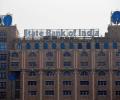
Country's largest lender State Bank of India (SBI) is looking to be among 10 top global banks in market capitalisation terms in the next five years, chairman CS Setty said on Wednesday. "The scope for value creation for the stakeholders is potentially very high. So the larger ambition is if the market supports whether we can be part of the top 10 global banks in terms of the market capitalisation (five years)," he said after listing of shares issued under Qualified Institutional Placement (QIP) at NSE.

The famous 'tareekh pe tareekh' dialogue from the Hindi movie Damini captures where we are now.
Market watchers link the pullback to underwhelming listing-day performance and the lack of big-name IPOs.
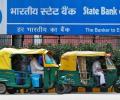
State Bank of India (SBI), the largest lender in the country, has launched a share sale to institutional investors to raise upto Rs 25,000 crore, the biggest qualified institutional placement (QIP) so far by an Indian firm, and has set a floor price of Rs 811.05, which is at a 2.5 per cent discount on Wednesday's closing price.
 © 2026 Rediff.com - Investor Information - Advertise with us - Disclaimer - Privacy Policy - Sitemap - Feedback - About us - Terms of use - Grievances